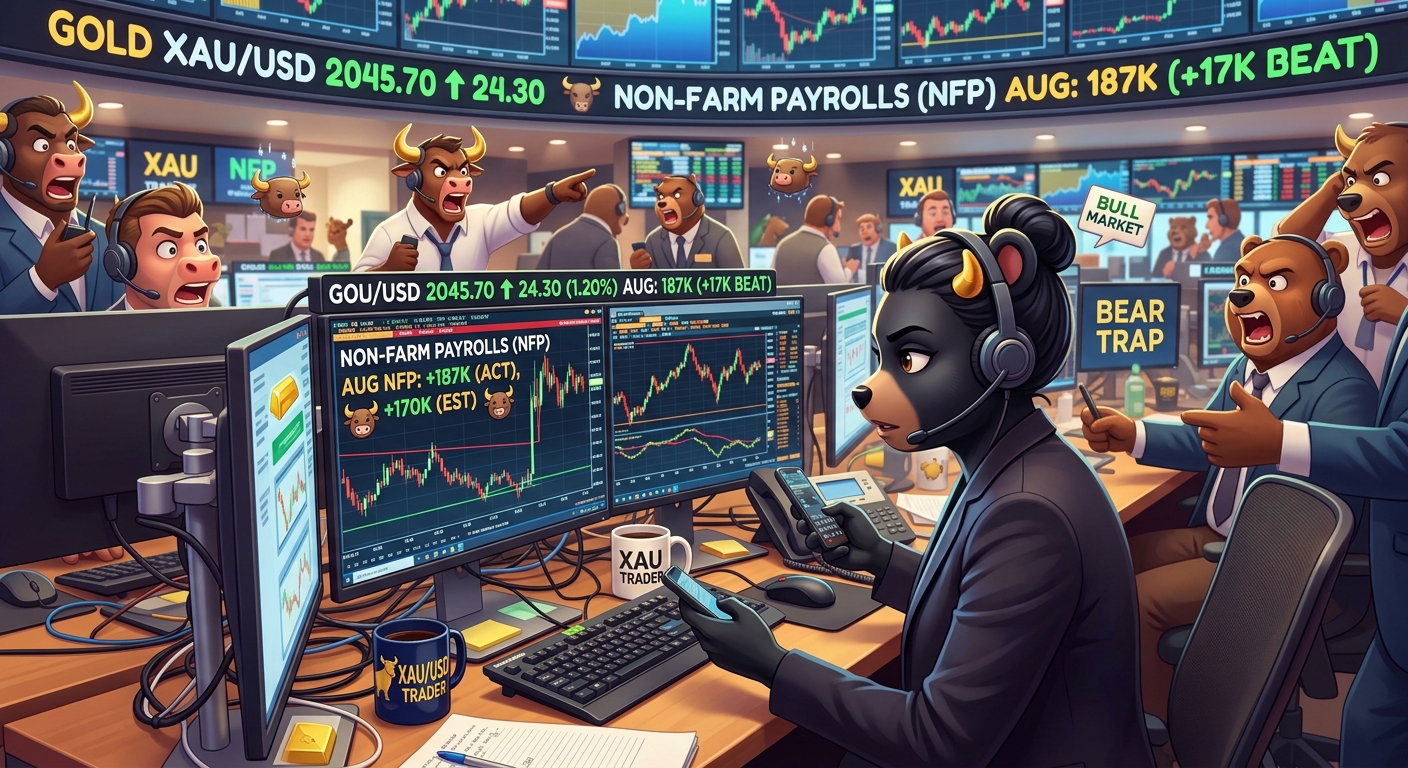
What's Happening
On the first Friday of every month, at 8:30 a.m. New York time, the U.S. Bureau of Labor Statistics releases the Non-Farm Payrolls report — and for a few minutes gold (XAU/USD) turns into one of the most volatile instruments on the planet. Moves of $20–40 per ounce within minutes are not unusual, and spreads can widen sharply right at the release.
Why does a jobs report about America move a metal that is mined in Africa, Australia and Russia? Because gold is priced in dollars, pays no interest, and lives or dies by what traders expect from the Federal Reserve. NFP is the single strongest monthly signal of where the Fed is heading.
Key Facts
- NFP measures how many jobs the U.S. economy added or lost last month, excluding farm workers, private households and non-profits.
- The release also includes the unemployment rate and average hourly earnings — wage growth is often more important for gold than the headline number.
- Strong NFP (above forecast) usually means a stronger dollar and higher bond yields — bearish for gold.
- Weak NFP (below forecast) usually raises expectations of Fed rate cuts — bullish for gold.
- Revisions to the previous two months can flip the market reaction entirely.
- The first spike is often reversed within 15–30 minutes as big players reposition.
Why It Matters
Gold has no yield. When rates are high, holding gold costs you the interest you could earn elsewhere. When the labor market cools and the Fed signals cuts, that "opportunity cost" falls and money flows back into gold. That is why a weak jobs number can send XAU/USD sharply higher in seconds.
But the market does not trade the number itself — it trades the surprise. If economists expect +150K jobs and the print is +155K, gold may barely react. If the print is +40K, or wages jump unexpectedly, expect fireworks. Context also matters: during geopolitical stress or heavy central-bank buying, gold can rally even on a strong report.
How Traders Approach Gold on NFP Day
- Know the consensus: check the forecast for payrolls, unemployment and wages before 8:30 a.m. ET.
- Watch the dollar index (DXY) and 10-year yields: they confirm or contradict gold's first move.
- Reduce position size: slippage and wide spreads are normal in the first minutes.
- Always use a stop-loss: a $30 swing against you is very possible.
- Consider waiting: many professionals skip the first spike and trade the retest 15–30 minutes later.
Where to Trade Gold: RoboForex
If you want to trade XAU/USD around NFP and other macro releases, the choice of broker matters — execution speed, spreads and platform stability are tested hardest on exactly these days. RoboForex is an international broker operating since 2009 that offers gold, forex, indices, stocks and crypto CFDs on MetaTrader 4, MetaTrader 5, cTrader and its own R StocksTrader platform.
- Trade XAU/USD and XAG/USD with competitive spreads.
- Several account types, including ECN accounts for active traders.
- Low minimum deposit and a free demo account to practice NFP strategies without risk.
- Copy trading service (CopyFX) if you prefer to follow experienced traders.
👉 Open a RoboForex account here
Risk warning: CFDs and leveraged products carry a high level of risk and may not be suitable for all investors. You can lose more than your initial investment. This article is for informational purposes only and is not investment advice.
FAQ
Does gold always go up when NFP is weak?
Usually, but not always. Gold reacts to the surprise versus expectations, to wage data and to revisions. If wages rise strongly while jobs disappoint, the reaction can be mixed or even negative for gold.
What time is the NFP release?
Typically the first Friday of the month at 8:30 a.m. Eastern Time (12:30 or 13:30 GMT depending on daylight saving time).